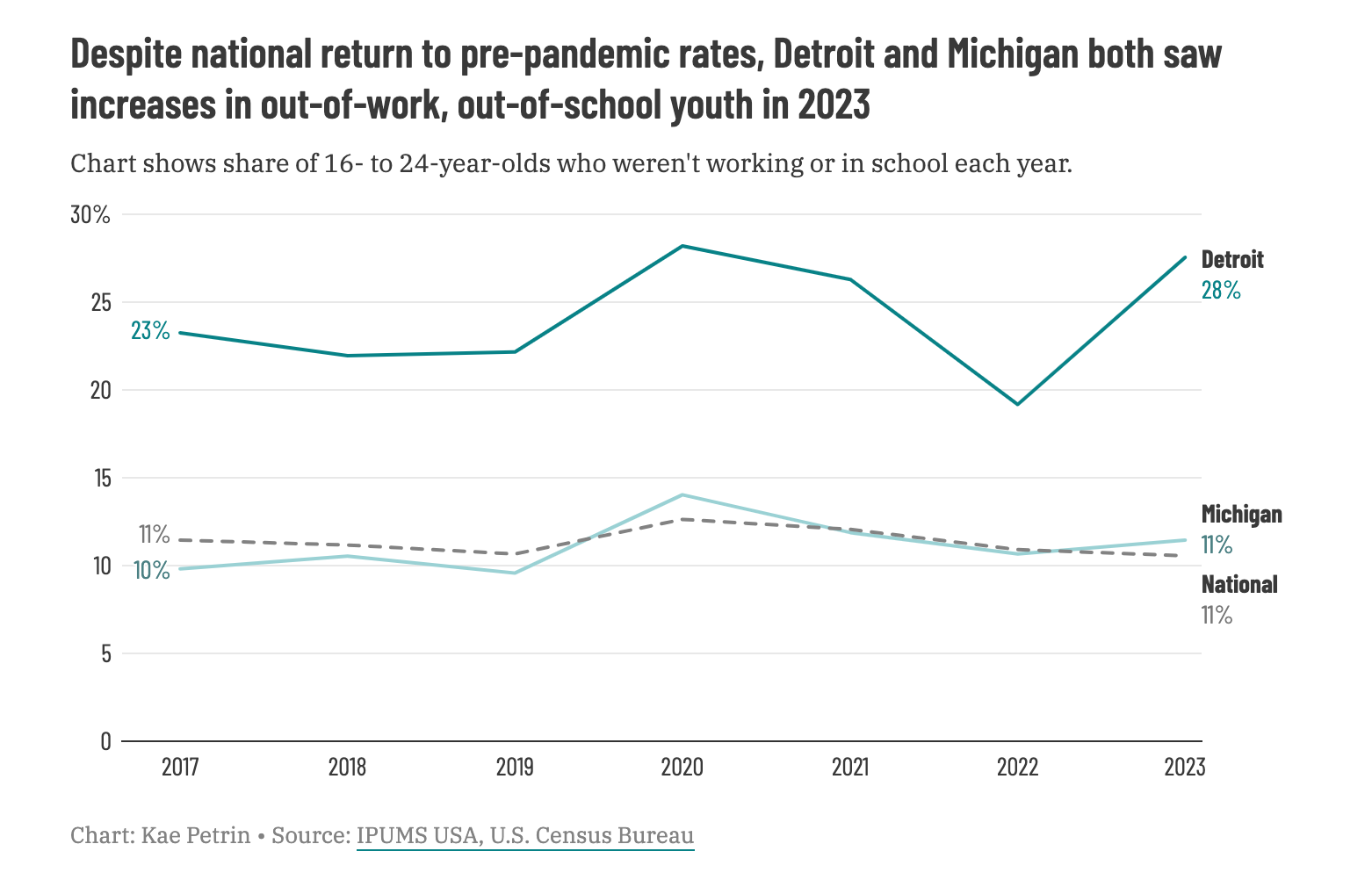
Kae Petrin // Chalkbeat The results so far in Detroit illustrate the challenges that persist. Ericka Page, point person for youth programs at the Detroit Employment Solutions Corporation, the agency contracting with the six nonprofits running programs, said data on these programs’ outcomes shows many young people bouncing in and out of re-engagement programs and from job to job. Often, these are minimum-wage, part-time, or gig jobs. The programs are connecting with youth and getting some of them employed. But sustaining their momentum over the extended time it takes to remake their lives is hard, Page said. “The biggest challenge with opportunity youth is retention,” says Ann Leen, who heads the SER Metro center. “It could be a $15 an hour job. It could be the streets calling. It could be, ‘Mom needs help.’ It could be, ‘It’s just too hard.’ We have to be louder than those other voices.” On the afternoon Seth burst into the SER lobby, the staff helped him calm down. But after that day, he started showing up less and less. By last spring, he had stopped coming. By fall, he returned, on and off. By winter, Tejada worried he was losing him again. Lucian was not alone at the park when he harmed himself on Mother’s Day 2023. A friend who was with him called an ambulance that rushed him to the emergency room. He spent a week at a psychiatric hospital. When he left, staffers from Urban Neighborhood Initiatives kicked into high gear. They set him up with an outside therapist and gave him rides to appointments. When he stopped going, they pushed him to go back. They found him a bed at a small shelter all the way across the city. Lucian was eager to get back to work. He needed the money, but he also missed the steadying rhythms of working full-time. He walked the drab commercial stretch with boarded-up storefronts near the shelter and found the few businesses left were not hiring. For occasional shifts at a fried chicken place in his old neighborhood, he sometimes commuted as much as two-and-half hours one way. Then in early 2024, a friend invited Lucian to move in with him, his mom, and his eight siblings in a house not far from Los HQ. The move back to the Springwells neighborhood was a game-changer, bringing him closer to jobs and friends. By this spring, he was on full-time grill duty at Family Treat. He had picked up more shifts at the fried chicken place. And UNI brought him on to help out with the culinary program two evenings a week and soon promoted him to program lead. At that rate, he felt, he might be able to afford to rent his own place with a friend by summer’s end. Across the country, young people like Lucian had been getting back to work, pushing post-pandemic disconnection rates down as the labor market ramped up. But some experts and advocates worry there’s a catch to that good news. Kristen Lewis, director of the think tank Measure of America, says she worries that many young people are choosing unstable jobs that can breed more disconnection in the longer run over opportunities to finish high school and get training that could actually open up a path out of poverty. The post-pandemic data has reaffirmed something experts knew before COVID-19: The fates of vulnerable young people like Lucian are chained to their ZIP codes and the whims of the economy. “We’ve been searching for silver bullets: Summer jobs will solve everything! Mental health care will solve everything!” she said. “But look at the deep structural problems and profound inequities some neighborhoods face. It’s the story of what’s wrong with America.” Lucian, too, felt keenly the precariousness of his situation last spring. His worries came to a head when a diabetic seizure struck near the end of his shift at Family Treat one April afternoon. He had just started on an order of five footlongs in the narrow kitchen when a buzzing in his ears muffled the sizzle of the fryers, and his vision faded to white. As he convulsed on the floor, his manager kneeling beside him, one thought cut through Lucian’s brain fog: He had to get back to making hot dogs. He couldn’t lose that $11.50-an-hour job–and the fragile stability he’d just started regaining. Lucian staggered up to his feet. His vision still swam, and arms stung as though jabbed by needles. But he dashed back to his work station, where the hot dogs he had set on the grill still rotated. “You still need five of these, right?” Lucian called to the young woman working the front register. This November, with Family Treat closed for the season, Lucian, now almost 20, walked into a GED prep classroom in Southwest Detroit. UNI had referred him to the program, which would pay him $200 a week and introduce him to a career in carpentry. Lucian felt it would be good insurance against the fickleness of restaurant work–and a chance to finally tackle his longtime goal of getting a high school credential. But uncertainty still plagued Lucian. He and his roommate were both unemployed, and the bills kept coming. The staff at UNI collected almost $400 for Lucian’s November rent and got him a free Thanksgiving turkey. He was quickly learning that it was tough to find a job while tied up in a carpentry and GED program for most of the day. Some advocates worry that the COVID-19-era sense of urgency around opportunity youth might be fading even as many young people like Seth and Lucian haven’t yet regained their footing. But boosting funding for re-engaging and training disconnected youth has been a key area of bipartisan consensus in the federal push to reauthorize the Workforce Innovation and Opportunity Act, which expired in 2020. Lawmakers launched a bipartisan Opportunity Youth caucus this summer. And a bipartisan agreement on the law earlier this year would have steered more money to youth programs, including a new $65 million apprenticeship program. But in late December the bill was shelved amid a congressional standoff over funding the federal government, leaving uncertain the fate of the law and the programs it powers. On the campaign trail, President Donald Trump and running mate JD Vance at times appeared to speak directly to young men like Lucian and Seth, promising a return to an era of robust manufacturing and access to good jobs that don’t require college. But practitioners worry about what the incoming administration’s appetite for federal spending cuts might mean. In Detroit, the Ballmer Group, former Microsoft CEO Steve Ballmer’s foundation, has been pushing the city for a big-picture vision for attacking youth disconnection. Here and nationally, the focus is shifting back to the training and credentials young people need to access high-demand jobs employers are trying to fill. It’s impossible to know where Lucian and Seth would be now if their lives had not intersected with the agencies and people helping them. But their experiences these last few years affirm that young people who become disconnected from school and work need more than jobs that pay the bills. They need social-emotional backing–and also a way to see a clear path to more stable, fulfilling lives. Their stories show that rebuilding after a stint of disconnection takes time. And programs often aren’t set up to serve young people in the long run, so the years ahead could bring more uncertainty. It’s easy, Lucian realizes, to miss the growth he’d made amid the rollercoaster of the last three years. He is taking better care of his physical and mental health. Time spent “jotting and rambling” in his journal about his long-term goals grounds him. Dillard moved to the West Coast earlier this year, but they’ve stayed in touch, catching up on Zoom. She told him she was proud of him. He told her he was anxious, but also determined. “I think a lot about the future,” Lucian said this month. “I am always thinking about when I am going to reach my goals–not if.” This story was produced by Chalkbeat and reviewed and distributed by Stacker.
'The kids everyone forgot': The faltering post-pandemic push to reengage teens and young adults not in school, college, or the workforce
Feb 4, 2025 | 10:00 AM