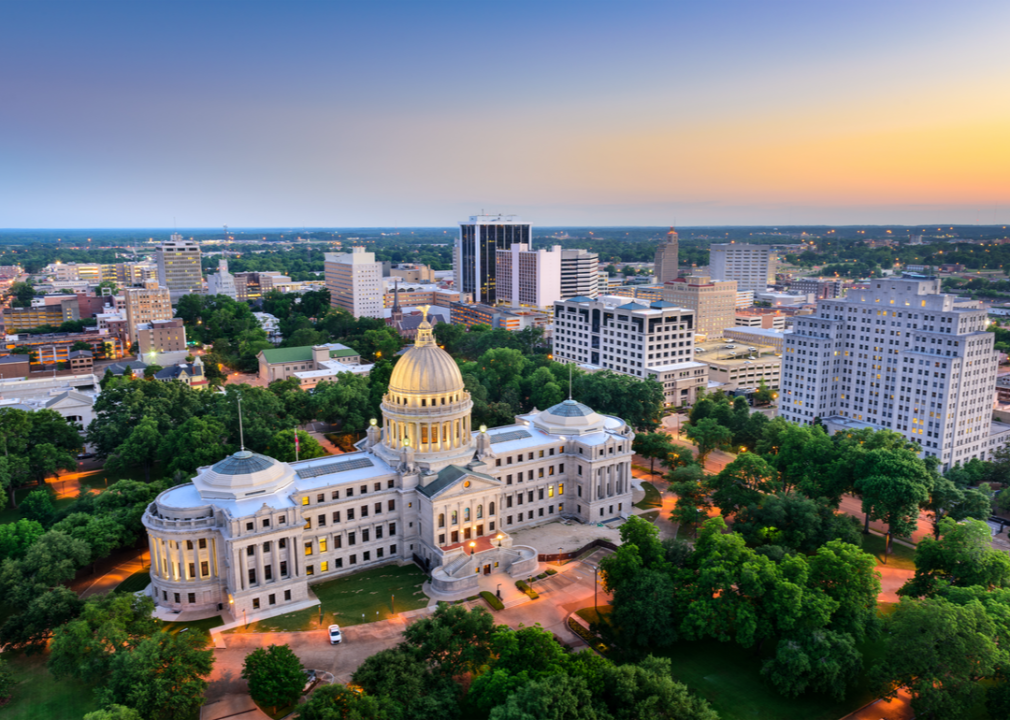
Bettmann // Getty Images There were over 2.1 million pay phones in the U.S. at their peak in 1999, but now the technology is mostly relegated to nostalgia. Few wall-mounted pay phones linger in strip malls, and the silver and blue phone booths are mostly gone from the busy streets they once dotted in many parts of the U.S. Pay phones have become so rare that the FCC stopped requiring audits of them in 2018. Spokeo used data from the Federal Communications Commission to explore the fall of pay phones across the United States. States are ranked by the percentage decline in the number of pay phones between 2000 and 2016. For ties, the number of pay phones remaining in the state was next used to rank. Though no longer updated, the available data paints a picture of the pay phone’s sharp decline. The disappearance of this once-ubiquitous technology makes sense. According to the Pew Research Center, about 97% of U.S. adults own a cellphone today, most of whom specifically own smartphones. Pay phones can be especially useful in areas where cell service falls short. These include national parks, certain hospitals, and around the U.S. border. Pay phone connections can also hold steady when natural disasters disrupt cell service, and operators report increased usage during disasters. Most states saw the number of pay phones decline by over 90% between 2000 and 2016, but one outlier stood out: Hawai’i. The island state saw the number of pay phones drop by about 60%. A spokesperson for Hawaiian Telcom, the leading pay phone operator in the state, told the Honolulu Civil Beat that national trends may simply be taking longer to play out. Other telecommunications experts think tourism plays a role as international travelers visiting the state may find it cheaper to make a pay phone call than pay mobile fees for calling from the U.S. Based on International Trade Association data, and relative to its residential population, Hawai’i has the highest number of international travelers, receiving about 67 global visitors for every 100 residents in 2022. A national look Spokeo As of 2016, under 100,000 pay phones remained in the U.S., a 95% decline from 2000, when there were over 2 million. This number has likely shrunk significantly since the FCC last collected the data. In 2016, New York state accounted for 1 in 5 of the country’s remaining pay phones, but many have since been converted for new purposes. New York City removed its last public pay phone in 2016. While some privately operated phones remain, many of the city’s phone booths have since been transformed into Wi-Fi corners, embracing a smartphone-centered era of technology. Read on to find out how pay phones have declined in every state and Washington D.C. during the 2000s and 2010s. #51. Hawai’i image_vulture // Shutterstock – 59.6% decline in number of pay phones – Number of pay phones remaining in 2016: 3,615 (253.2 phones per 100K people) — Down from 8,943 in 2000 (736.9 phones per 100K people) #50. West Virginia Sean Pavone // Shutterstock – 85.7% decline in number of pay phones – Number of pay phones remaining in 2016: 1,678 (91.6 phones per 100K people) — Down from 11,704 in 2000 (647.7 phones per 100K people) #49. New York Little Vignettes Photo // Shutterstock – 87.9% decline in number of pay phones – Number of pay phones remaining in 2016: 20,716 (105.5 phones per 100K people) — Down from 171,098 in 2000 (900.4 phones per 100K people) #48. Nebraska Canva – 88.1% decline in number of pay phones – Number of pay phones remaining in 2016: 1,150 (60.3 phones per 100K people) — Down from 9,668 in 2000 (564.1 phones per 100K people) #47. Alaska
The decline of pay phones in every state
Jun 11, 2024 | 3:00 PM