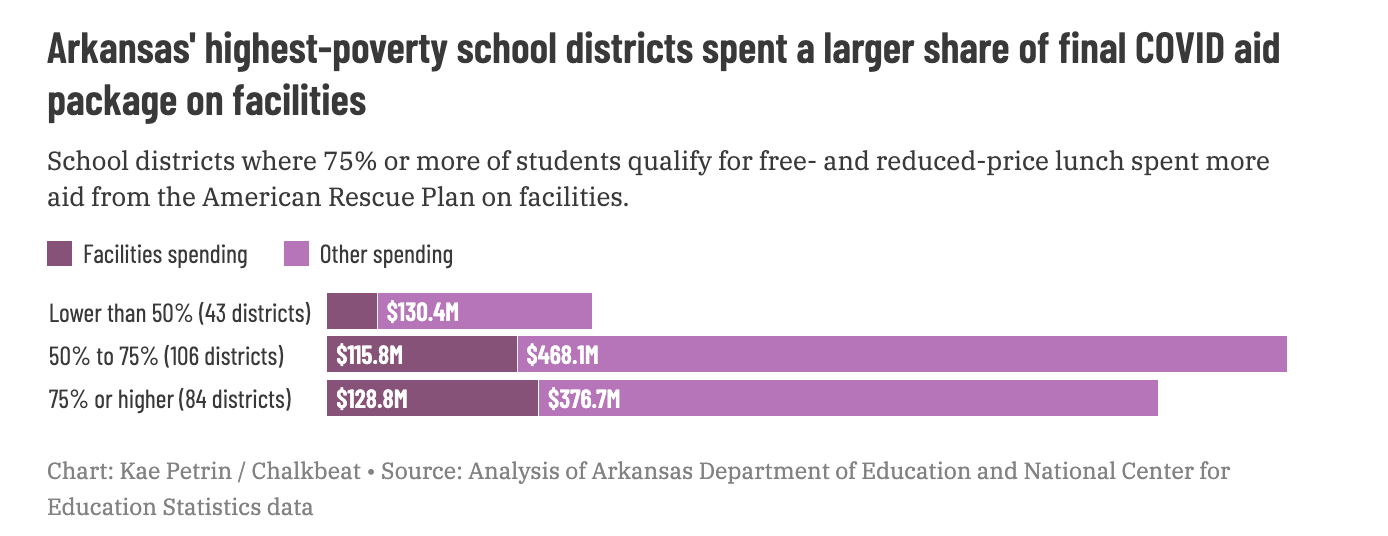
Nate Smallwood for Chalkbeat When the air conditioning broke in a Terrebonne Parish school, it sometimes got so hot that kids fainted or had asthma attacks, and the school had to call an ambulance. More often, the school sent kids home early. In the best-case scenario, students packed into classrooms with working AC or relocated to the gym or cafeteria to escape the southeast Louisiana heat. So when the school district got its final federal COVID-19 relief package in 2021, school officials made fixing the AC a top priority. Nearly $23 million — more than 40% of the district’s aid allotment — went to replace the most dire HVAC systems in seven schools. “It gives us the confidence that we’re not going to have to cancel school, the kids are not going to get sick,” Superintendent Bubba Orgeron said. “When it’s either too hot or too cold … kids are focused on that instead of learning.” Handed billions of dollars with few strings attached, thousands of school leaders made a similar calculation that year. Across 21 states with publicly available data, schools on average planned to spend 18% of their third and largest COVID-19 aid package on facilities, a Chalkbeat analysis found. That’s nearly as much as they were required to spend on academic recovery. In Mississippi, schools put nearly 40% of their final aid package toward buildings. In South Dakota, it was more than half. Ripping off the duct tape and fixing the facilities Mia Hollie // Chalkbeat As the nation takes stock of its return on this massive one-time investment, many school leaders stand behind their decision to go big on facilities, and say this will pay dividends for academics and student engagement. A growing body of research suggests a child’s learning environment affects their test scores and attendance. But recent research points to a potentially troubling trend: High-poverty districts, like Terrebonne Parish, were more likely to budget a greater share of their final aid package for facilities and operations, especially costly projects like new construction and building repairs. That left them less to spend on academic recovery — even though they educate the kids who’ve had the most academic ground to make up. Those patterns speak to how the pandemic and months of school closures collided with decades of deferred maintenance and underinvestment in school facilities. Those same high-poverty districts were especially in need of major building upgrades, a 2023 Urban Institute report found. If districts felt like they had to use this money to fix school buildings even in the face of “a massive learning loss challenge,” said Christopher Brooks, an education researcher who analyzed how thousands of districts planned to spend their third relief package, “I think that’s really telling.” Why schools spent COVID-19 aid on facilities U.S. schools got a total of $190 billion in federal pandemic aid. The American Rescue Plan, the last and largest package, provided $123 billion to K-12 schools, and required them to put 20% toward academic interventions for kids. Federal officials said that money was meant to help reopen schools and make up for interrupted learning. But local leaders had broad discretion to decide what that looked like. Some schools used the money to hire social workers, expand summer school, and stand up new tutoring programs. But other school leaders gravitated toward improving facilities, worried they could not maintain added staff or programs once the “fiscal cliff” arrived and the aid ran out. Some politicians and school finance experts encouraged schools to spend pandemic aid on one-time costs. That argument resonated with certain state and local officials. “South Dakotans are practical people,” Mary Stadick Smith, a state education agency spokesperson, wrote in an email explaining why schools there budgeted roughly $183 million to repair buildings and improve air quality. “School leaders made investments that they believed would provide sustained benefits to students and positively impact their schools for the long term — without imperiling budgets with unsustainable spending.” The lack of guardrails led to some questionable spending on things like relaxation rooms with massage chairs and football fields. But many districts used their biggest pandemic aid package for more pressing facility needs. A Chalkbeat review of 7,000 district spending plans compiled by the company Burbio, for example, found that more than 3,300 planned to spend some of the aid on HVAC or air filtration. Hundreds of districts budgeted more than half of their final aid package on air quality improvements. The need was widespread: More than a third of all public schools had HVAC systems requiring repairs when the pandemic hit, a 2020 Government Accountability Office report estimated. Terrebonne Parish’s ACs were so old, for example, that maintenance workers struggled to find replacement parts. “Everything was hanging on by duct tape,” Orgeron said. Federal officials pushed schools early on to improve ventilation, and have continued to endorse that spending. When Education Secretary Miguel Cardona was asked in late May if he thought spending on facilities had taken away from the priorities he laid out earlier this year — tutoring, summer school, and attendance — he said no. “We are seeing that the dollars were used on what they were supposed to be,” he told Chalkbeat at an Education Writers Association event. Improving air quality so kids could return to in-person learning was part of that equation, he added. To some school leaders, investing a lot in certain highly touted academic recovery strategies, such as intensive tutoring, felt risky because they saw other districts struggle to get it right. But they trusted building repairs would pay off. Arkansas’ Decatur School District considered hiring tutors with its last COVID-19 aid package. But a committee of staff, students, and parents ultimately decided against it because schools wouldn’t be able to afford their salaries after the money ran out. The rural district serves 570 students, nearly 80% of whom come from low-income families. It spent almost 70% of its biggest aid package on facilities, including air conditioning, ventilation, windows, and doors. “Do you want to spend it on technology that’s obsolete in two or three years, or do you want to spend it on staff who, once the money sunsets, you have to let that staff go?” Superintendent Steven Watkins said. “We took that money and looked at the long-term goals.” High-poverty school districts spent big on buildings
COVID-19 aid funded big repairs at high-poverty schools. Will that give academics a boost too?
Aug 8, 2024 | 9:00 AM