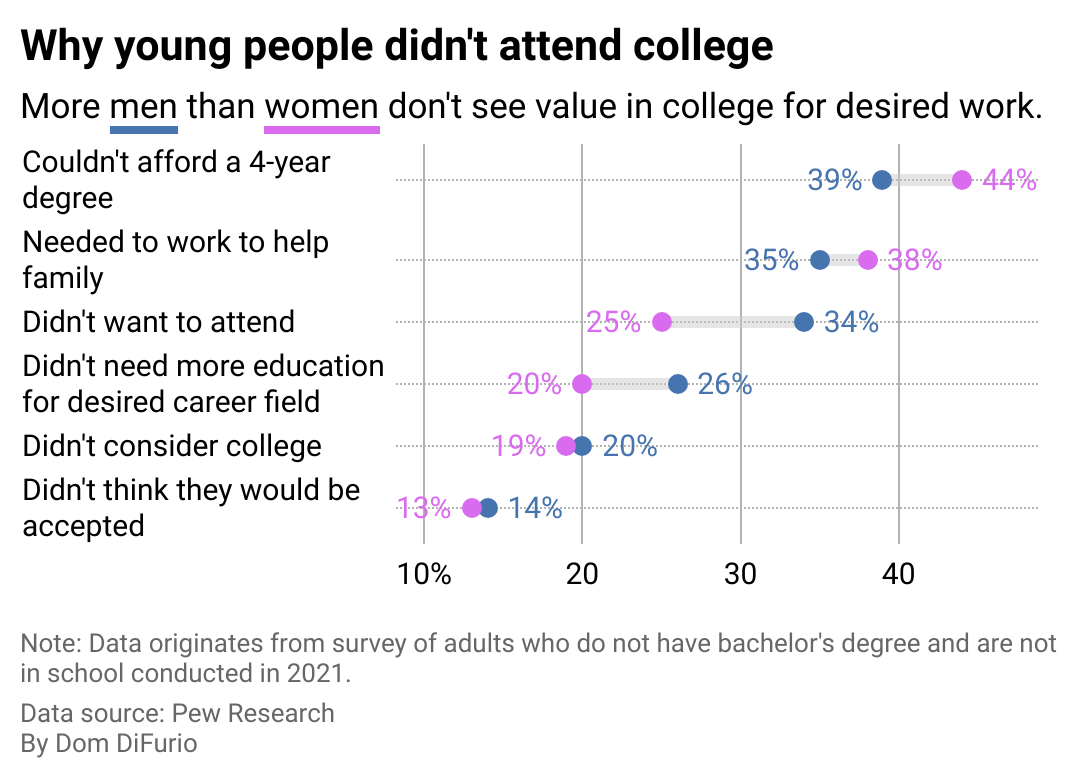
BublikHaus // Shutterstock The number of young men pursuing U.S. college degrees has fallen in recent years. In 2022, there were 1 million fewer American men ages 18-24 enrolled in college than there were in 2011, according to Pew Research Center. Fewer women are also going to college, but just slightly, with the number at 200,000. With noticeably fewer men enrolling in higher education, the widening gender discrepancy has left many college administrators, educators, and economists wondering why young men are fleeing the system in alarming numbers. And the trend is mirrored in most countries. For starters, men who forgo college have a worse financial outlook. Those men, some of whom say they want a quick entrance into the job market, can expect a loss of nearly $1 million in lifetime earnings on average, according to Georgetown University. The challenge of attracting men to enroll in and graduate from college is not new–it’s existed since the Great Recession and worsened during the coronavirus pandemic–but recent data shows that it’s getting even worse. To understand the dynamics at play, Spokeo analyzed data from the Department of Education’s National Center for Education Statistics to explore the yearslong decline of young men’s college enrollment. Overall college attendance by young men has dropped significantly Spokeo Most high school graduates in the U.S. enroll in college, as has been the case for the past half century. But in recent decades, women have outpaced men. The gender gap becomes starker at four-year colleges. In 2022 only 42% of undergraduates were men compared to 47% of the student body in 2011, according to Pew Research Center. Meanwhile, at two-year colleges, the gender figures have remained stable, with men accounting for 49% of the population in 2022, up from 48% in 2011. “I do notice that a lot of young men don’t want to go to college,” explained Osirus Polachart, a college counselor who works with high school students at Amethod Public Schools in Richmond, California, where a majority of the students are Latino. “What I notice from most of these kids at my school is that young men, especially in Latino households, are primarily concerned with, ‘What can you do for our family right now?’ College takes too long to make money because you have to do a minimum of four years until you begin looking for a job, so many of our kids head to work with their parents right after high school.” A 2021 Brookings Institution report noted that the gender gap is exacerbated by the fact that women complete four-year degrees in greater numbers–and do so more quickly. “Men are also less likely to graduate high school in the first place and less likely to complete college after enrolling,” the authors wrote. The result is lopsided. For instance, NCES data showed more than 1.1 million women earned a bachelor’s degree in 2018-19 compared to fewer than 860,000 men. Polachart said that among the students he works with, getting a college education isn’t considered a “manly” pursuit. “A lot of our young men then think that college is essentially for women who aren’t going into blue-collar jobs,” he said. “My students mainly prioritize vocational schools rather than college because through a vocation they can get that blue collar job that pays well.” For a growing number of young men, college has lost its luster or seems unattainable. It has left analysts, administrators, advisers, and more than a few college marketing departments struggling to figure out what young men want when it comes to higher education. What do young men want?
The decline of the college-educated American man
Feb 12, 2025 | 10:45 AM